
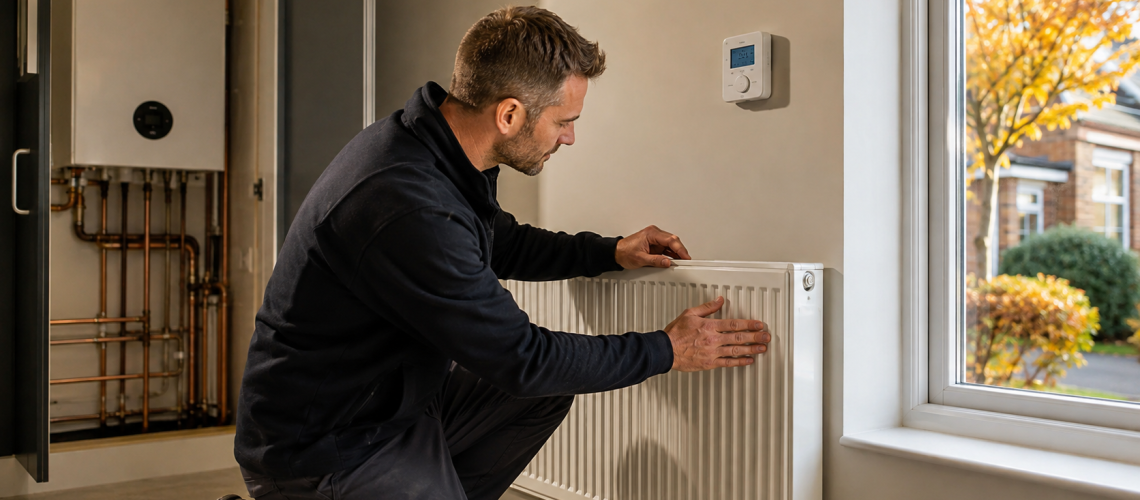
As the evenings become cooler, many households will switch their central heating on for the first time in several months. Ideally, the boiler will start, the radiators will warm up and everything will work exactly as expected.
However, a period of inactivity can reveal problems such as low boiler pressure, trapped air, sticking radiator valves or thermostat faults. Testing your heating before colder weather arrives gives you time to deal with any issues without being left in a cold home.
Here are the main checks to make when switching your central heating back on after summer.
1. Turn the Heating On Before You Really Need It
Do not wait for the first freezing evening before discovering whether your heating still works.
Turn the system on for around 20 to 30 minutes during early autumn. Set the thermostat above the current room temperature so that it calls for heat, then check that the boiler starts and the radiators begin warming up.
A short test run can reveal problems while heating engineers are generally less busy than during the first prolonged cold spell.
2. Check the Boiler Pressure
Low boiler pressure is one of the most common reasons a central heating system fails to operate correctly.
Many modern sealed systems should show a pressure of approximately 1 to 1.5 bar when the system is cold, although you should always follow the manufacturer’s instructions for your particular boiler.
If the pressure is too low, the boiler may display an error code or refuse to start. You might be able to repressurise the system using the filling loop, but only do this if you are confident and understand the instructions for your boiler.
Pressure that repeatedly falls could indicate a leak, a faulty pressure relief valve or a problem with the expansion vessel. Continually topping up the system will not fix the underlying fault, so arrange an inspection if the pressure keeps dropping.
3. Check Whether Every Radiator Heats Up
Allow the heating to run and carefully check each radiator around the property.
Different temperature patterns can point towards different problems:
- A radiator that is cold at the top may contain trapped air and need bleeding.
- A radiator that is cold at the bottom could contain sludge or debris.
- One completely cold radiator may have a stuck valve or circulation problem.
- Several cold radiators could indicate a wider issue with the boiler, pump or heating system.
Radiators do not always heat at precisely the same speed, particularly in a larger home. However, they should eventually become reasonably warm across most of their surface.
4. Look for Leaks and Damp Patches
Inspect visible radiator valves, pipework and the area around the boiler for signs of water.
Small leaks are not always immediately obvious. Look for damp patches, staining, corrosion, flaking paint or a greenish deposit around copper pipes and fittings.
Even a slow leak can gradually reduce the boiler pressure and cause damage to flooring, walls or ceilings. If you find water escaping from the system, do not ignore it simply because the heating still works.
5. Test the Thermostat and Heating Controls
Sometimes the boiler is working properly, but the thermostat or programmer is not telling it to turn on.
Check that:
- The thermostat is set to heating mode.
- The requested temperature is higher than the current room temperature.
- The date and time are correct.
- Your heating schedule has not been reset.
- Wireless thermostat batteries do not need replacing.
- Smart heating controls are connected and responding correctly.
If your controls have lost their settings following a power cut or battery change, the heating may operate at unexpected times or fail to start altogether.
6. Listen for Unusual Boiler or Radiator Noises
Central heating systems can make some noise as pipes and radiators warm up. Occasional clicks caused by expanding metal are usually normal.
However, loud banging, persistent gurgling, whistling or vibrating noises should be investigated. These sounds may be linked to trapped air, poor water circulation, limescale, sludge or a component beginning to fail.
Switch the system off and seek professional advice if the noise is severe or accompanied by leaking water, an error message or a burning smell.
7. Check Your Carbon Monoxide Alarm
Every home with a gas boiler should have an effective carbon monoxide alarm positioned appropriately and tested regularly.
Use the test button and check the alarm’s replacement or expiry date. Replacing the batteries does not extend the working life of an expired detector.
Carbon monoxide cannot be seen, smelled or tasted. Warning signs of an unsafe appliance can include soot, staining, excessive condensation or a pilot light that repeatedly goes out. If you suspect that a gas appliance is unsafe, turn it off and arrange for it to be checked by a Gas Safe registered engineer.
If you smell gas, open doors and windows, avoid operating electrical switches or naked flames and call the National Gas Emergency Service immediately on 0800 111 999.
Should You Bleed Your Radiators?
If a radiator is cool at the top but warm at the bottom, trapped air may be preventing hot water from filling it properly.
You can bleed the radiator using a suitable radiator key, a cloth and a container to catch any water. Turn the heating off first and allow the radiators to cool before opening the bleed valve carefully.
Once you have finished, check the boiler pressure because bleeding radiators can cause it to fall. If radiators regularly fill with air, there may be an underlying issue that needs professional attention.
When Should You Call a Heating Engineer?
Contact a qualified heating engineer if:
- The boiler will not start.
- An error code keeps returning.
- The pressure repeatedly drops.
- The boiler or pipework is leaking.
- Several radiators remain cold.
- The system makes persistent or unusually loud noises.
- Your hot water or heating is unreliable.
- You notice soot, staining or other possible signs of unsafe combustion.
Never remove the boiler casing or attempt to repair a gas component yourself. Gas boiler work must be completed by an appropriately qualified Gas Safe registered engineer.
Get Your Heating Ready for Autumn
Testing your central heating now can help identify minor problems before temperatures drop and demand for emergency heating repairs increases.
Gasure Plumbing & Heating provides professional boiler, heating and plumbing services throughout Grays, Thurrock, South Ockendon, Upminster, Stanford-le-Hope and surrounding areas of Essex and North Kent.
If your boiler will not start, your radiators are not heating properly or your system needs professional attention, contact Gasure Plumbing & Heating to arrange an inspection.
Call 07776 153 815 or 01375 405 943.